
Buy a home or rent (for life)?
Explore the affordability and potential impact on retirement savings in the UK. Should you prioritise buying a house or saving more in your pension?
Discover your financial future
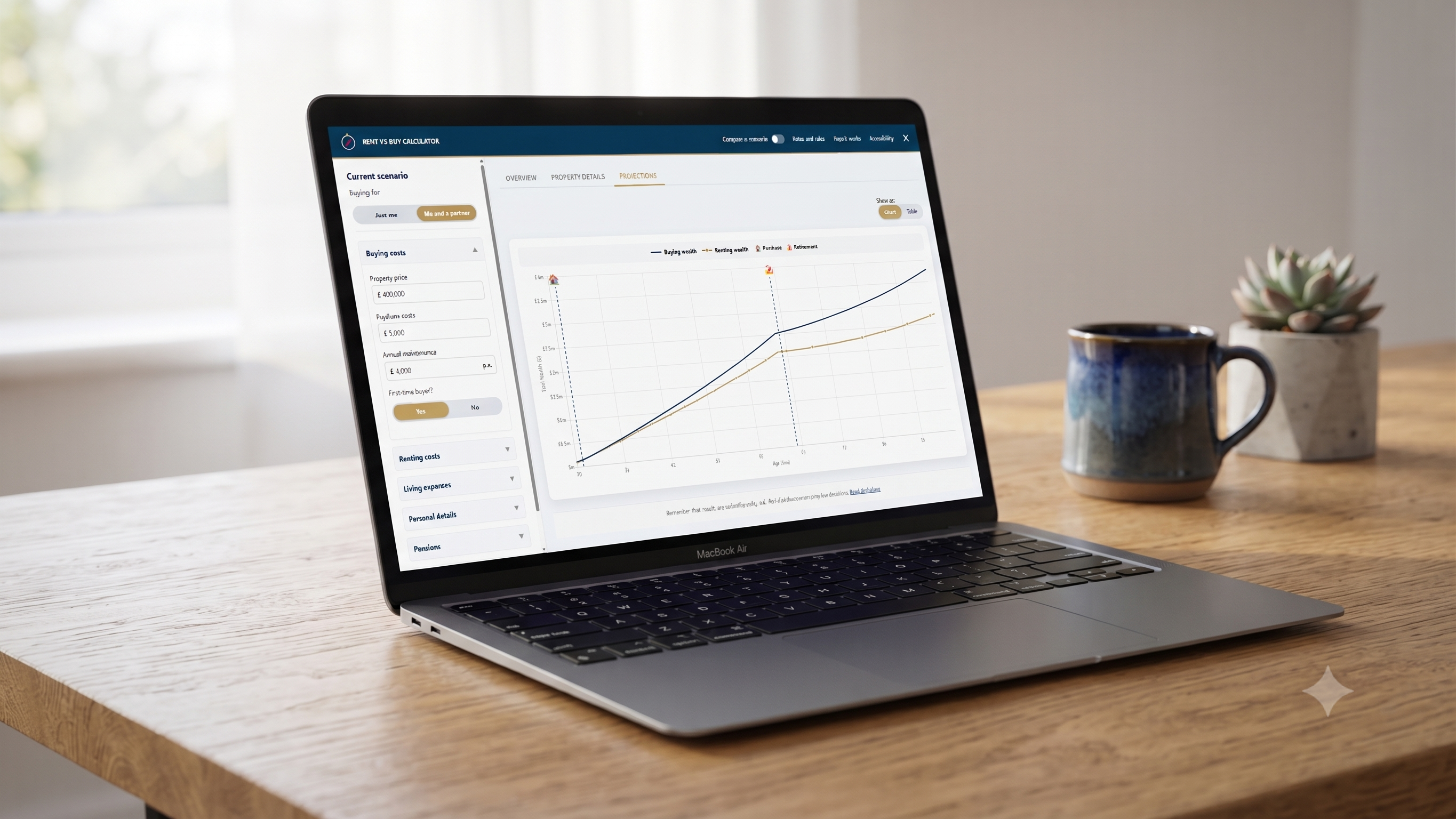
Our interactive tool projects your long-term wealth to help you compare the financial outcomes of buying a home versus renting for life.
What you can do with the calculator
Plan for just you or include a partner
Model your finances individually or combine incomes and expenses with a partner for a joint view.
Compare different scenarios
Easily see a clear comparison of your lifetime wealth if you buy versus if you continue to rent for life.
Include student loans
Factor in your student loan repayments (Plan 1, 2, etc.) for a realistic view of your net disposable income.
Adjust assumptions
Tweak key variables like salary growth, investment returns, and inflation to test how robust your plan is.
Real life scenarios
We modelled different life choices to see how they impact lifetime wealth and the prospects of becoming a homeowner. See how small changes make big differences.

James, 21
The "Unwilling Boomerang"
James moved back in with his parents after graduation. He pays low rent (£800 per month) but spends heavily on his lifestyle (£1,250 per month). He wants to buy a £200k flat.
- Buying is better: Generates ~£396k more lifetime wealth than renting.
- Power of family help: A £10k gift from parents cuts 2 years off purchase time and boosts final wealth by £67k.
- Impact of budgeting: Cutting expenses to £500 per month means he could buy 11 years earlier (at age 27).

Becky, 24
The "Independence Protector"
Becky values her independence and rents a 1-bed flat alone (£1,150 per month). High rent and lifestyle spending (£1,250 per month) leave little room for saving towards a £160k flat.
- Wealth depletion: Continuing to rent into retirement drains her lifetime wealth entirely.
- Compromising on space: Moving to a flatshare (£800 per month) allows her to buy 16 years earlier (at 30).
- Extreme frugality: Cutting expenses to £500 per month lets her buy at 28, shaving 18 years off her base outcome.
About the report
The Personal Financial Planning Working Party has developed a financial model to examine the acute trade-offs early-career households face between homeownership and pension saving.
Our analysis suggests that, under plausible economic conditions, early entry into homeownership is frequently a superior strategy for building net wealth compared to sustained renting, even with higher pension contributions.
Key drivers identified:
- Daily spending habits: Discretionary spending significantly impacts when you can afford a deposit.
- Current rent levels: High rent strengthens the financial case for buying. Low rent makes investing elsewhere more competitive.
- Family support ("Bank of Mum & Dad"): Cash gifts or reduced rent at home materially alter the timing of a purchase and long-term wealth trajectories.
Note: This model provides a quantitative framework for understanding financial interactions over a lifetime. It is not intended as individual financial or retirement advice.
Read the full paper
Dive deep into the methodology, detailed persona breakdowns, and extensive data analysis.
Ready to see your own projection?
Take control of your long-term planning. Use the calculator to explore how your lifestyle choices today impact your wealth tomorrow.
Launch the calculator